
What Are Relationship Spectrums?
We all experience different types of relationships in our lives—whether with co-workers, friends, family, acquaintances, or professional contacts. Each relationship requires an investment of resources, such as time, attention, money, honesty, respect, and loyalty. All of these are resources you are responsible to allocate and manage. To do this, you can think of your relationships as existing along a spectrum, ranging from "no relationship" to "very close relationship."
For those at the lower end of the spectrum, you invest minimal resources. For example, when you walk into a coffee shop for your favorite decaf mocha, you’re greeted by the barista who might say, “Good morning, welcome to your favorite coffee shop, how are you?” You’ll likely respond with a simple “Good morning, I’m good, how are you?” Here, you’re offering just enough time, attention, and respect to maintain a polite exchange—without much deeper involvement.
On the other end of the spectrum are relationships where you invest much more. For example, when you get home from work and your spouse is already making dinner, they might ask, “How was your day?” You respond with something deeper, “It was rough, my boss gave me my yearly review, and I won’t be getting the bonus I was expecting. How was your day?” From there, the conversation could continue for hours as you share your challenges and navigate the emotional weight of the situation together. In this relationship, you offer significantly higher levels of your time, attention, honesty, and loyalty.
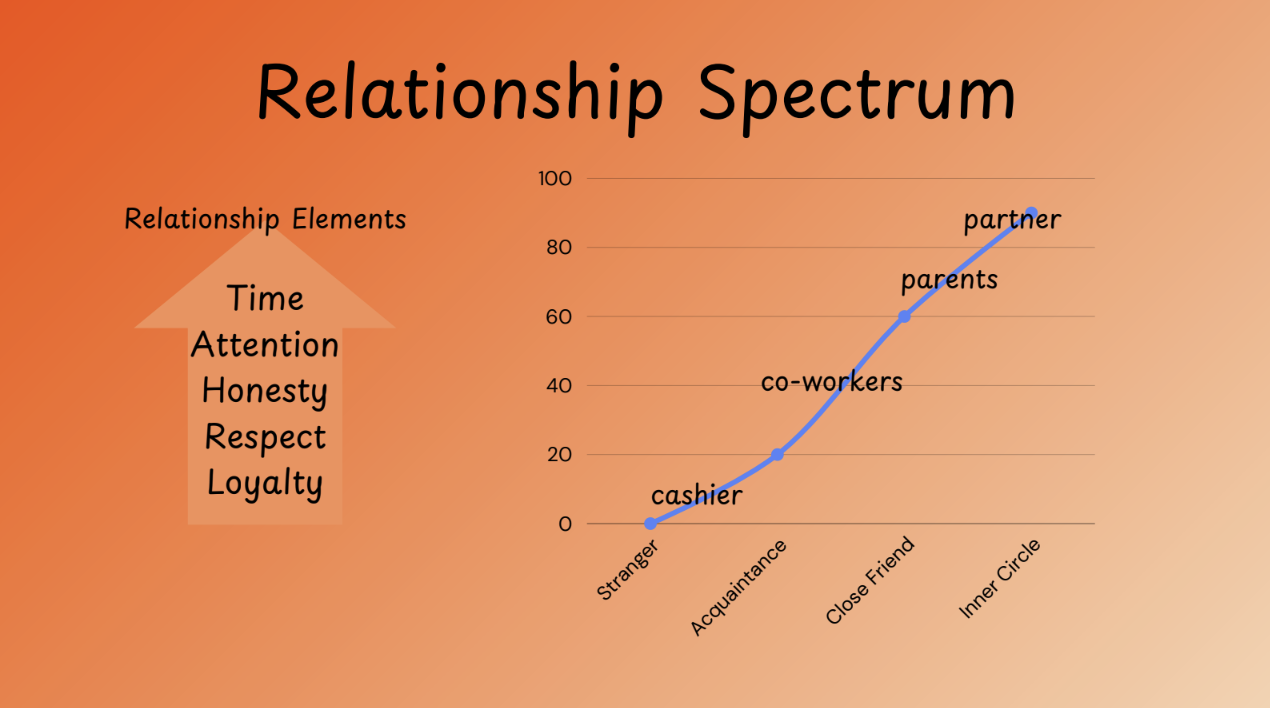
Visualization of the relationship spectrum, Created by Clinical Social Work/Therapist, MSW, LICSW
Here are some key points to remember about this relationship spectrum:
1.) Understand where each relationship falls on the spectrum.
It’s important to have clarity about the level of investment you should be putting into each relationship based on its position.
2.) Adjust placements when necessary.
If a relationship is placed too high or too low on the spectrum, it’s crucial to recalibrate. This often happens in family relationships, where people expect more from others based on their roles, like parents expecting adult children to maintain a high level of closeness despite a lack of effort on the child’s part. Similarly, children may expect more from parents who aren't emotionally present. Holding someone in a position they haven’t earned can lead to frustration and disappointment.
3.) Avoid unnecessary hurt and resentment.
If you’ve placed someone too high on the spectrum without them contributing in kind, it can create a buildup of hurt and resentment. This can be avoided by managing expectations and ensuring that relationships stay balanced.
Ultimately, relationships thrive when there is a mutual understanding of where each person stands on this spectrum. By managing your expectations and adjusting your investments accordingly, you can maintain healthier, more realistic connections with others.